Overview
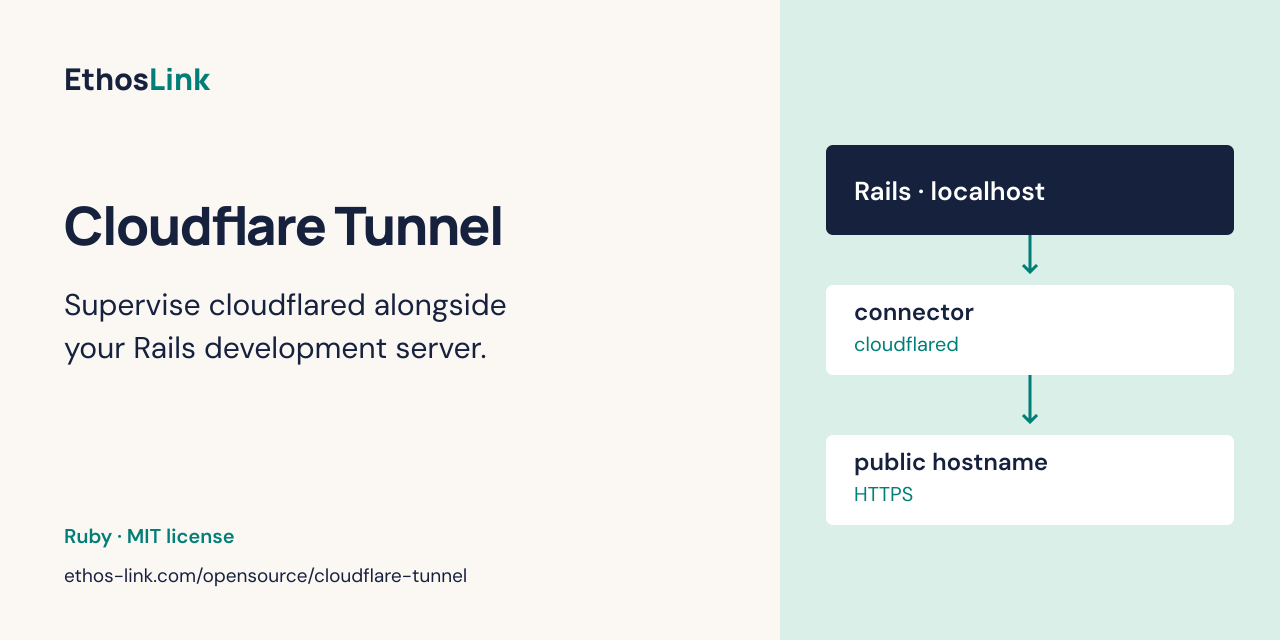
Supervise a host-installed cloudflared connector alongside Rails development. It is for Rails developers exposing a local development server through an existing tunnel. The gem does not install cloudflared, create tunnels or configure DNS. Rails tasks refuse to run outside development.
Installation
Ruby 4.0 or newer on a POSIX host (Linux or macOS). Rails integration requires host-installed Rails 8.1 or newer, below Rails 9. Install cloudflared separately and create a remotely-managed Cloudflare tunnel.
gem install cloudflare-tunnel
For a Bundler application, add gem "cloudflare-tunnel" to its Gemfile and run bundle install.
Use only the development group, as shown below.
Quick start
bundle add cloudflare-tunnel --group development
bin/rails generate cloudflare_tunnel:install --hostname=devel.example.com --port=3000 --metrics-port=20241
The generator creates config/initializers/cloudflare_tunnel.rb and a tunnel entry in Procfile.dev. Before bin/dev, configure the Cloudflare hostname and origin and save the connector token as described below. Booting Rails alone never starts a connector.
Usage
Rails setup
Add to the development group:
group :development do
  gem "cloudflare-tunnel", "~> 0.1"
end
bundle install
bin/rails generate cloudflare_tunnel:install \
  --hostname=devel.example.com --port=3000 --metrics-port=20241
The generator creates config/initializers/cloudflare_tunnel.rb and adds
tunnel: bin/rails cloudflare_tunnel:start to Procfile.dev.
Install the executable yourself using Cloudflare’s instructions. When missing, the start task prints that link once and stays idle so Foreman keeps other services running. The check task reports it and exits with failure.
In Cloudflare, configure a remotely-managed tunnel’s published application
hostname to use http://localhost:3000 (match your Rails port). Store its
connector token with bin/rails credentials:edit:
cloudflare:
  tunnel:
    token: YOUR_TUNNEL_TOKEN
TUNNEL_TOKEN overrides credentials. Tokens use temporary files with mode 0600,
stay out of command arguments and diagnostics, and are removed on normal exit,
INT and TERM. A forced OS kill cannot run cleanup; remove abandoned
cloudflare-tunnel-*.token files from your OS temporary directory if needed.
bin/dev
# In a second terminal, after Rails and the tunnel are running:
bin/rails cloudflare_tunnel:check
Adding the gem or booting Rails never starts a tunnel. Only the explicit start task does. Tasks refuse to run outside development. The diagnostic middleware is installed only in development. The generated initializer guards against the gem being excluded from other Bundler groups.
Configuration
if Rails.env.development?
  Cloudflare::Tunnel.configure do |config|
    config.hostname = "devel.example.com"
    config.origin = "http://localhost:#{ENV.fetch('PORT', '3000')}"
    config.metrics_port = 20241
    config.log_level = :error
    config.log_path = "log/cloudflare-tunnel.log"
    config.retry_interval = 30
  end
end
| Option | Default | Purpose |
|---|---|---|
hostname |
required | Bare public hostname configured in Cloudflare |
origin |
http://localhost:$PORT (3000 otherwise) |
Expected Rails origin; change Cloudflare’s origin setting separately |
metrics_port |
20241 |
Readiness/metrics port bound to 127.0.0.1; choose a distinct port for every concurrent app |
log_level |
:error |
Native cloudflared level: :debug, :info, :warn, :error, :fatal
|
log_path |
log/cloudflare-tunnel.log |
Append connector output here, relative to Rails root; nil discards it |
retry_interval |
30 |
Seconds before restarting an exited connector |
shutdown_timeout |
5 |
Seconds after TERM before killing a stuck child |
check_timeout |
5 |
HTTP connection/read/write timeouts, per diagnostic request |
executable |
cloudflared |
Name on PATH or an explicit filesystem path |
enabled |
true | False when TUNNEL is 0, false, off or no; configurable explicitly |
token |
lazy Rails credentials / TUNNEL_TOKEN
|
String or callable; keep real tokens out of initializers |
The connector handles its own reconnections. If it exits, the supervisor retries
after retry_interval, without recurring terminal messages. Disabled tunnels,
missing credentials and invalid configurations print one actionable message and
stay idle. Fix configuration and restart. The check fails for those states.
Use TUNNEL=0 bin/dev to disable the connector. Use your local Rails URL offline.
OAuth callbacks and provider requests still need internet. Turnstile behavior
remains application-owned.
The native log level filters cloudflared messages. Connector output stays out of
Rails logs and recurring Foreman output. Set log_path = nil to discard it.
Ignore log/ and tmp/ in Git; appended logs need normal local cleanup. Debug
logs may include request details; enable that level only while diagnosing.
A per-app file lock prevents two gem-managed connectors in the same working directory. Stop older Docker or system-service connectors for that tunnel yourself. Other working directories can still run replicas and receive traffic.
Diagnostics
bin/rails cloudflare_tunnel:check returns 0 only when all checks pass:
- Configuration, executable availability and token presence.
- The local Rails origin returns a fresh signed probe response.
- The connector’s
/readyendpoint reports an active Cloudflare connection. - HTTPS on the public hostname returns the expected response from this app.
The development-only /.well-known/cloudflare-tunnel?nonce=… probe uses an HMAC
with a purpose-specific key derived from Rails’ secret key base and returns
Cache-Control: no-store. It creates no records and exposes no credentials.
Fresh nonces prevent stale cached health pages passing the check. The signature
identifies the application’s key, not a particular machine sharing that key.
The configured metrics port must belong to this connector.
Failures identify the layer and return 1, including offline failures. The check
does not start a connector or change configuration. Redirects, Access login pages
and incorrect origins/app keys fail. Executable availability alone does not
validate the token; the running connector and end-to-end checks establish that.
Authentication errors remain in the separate connector log. No Cloudflare
management API token is required.
References: run parameters and readiness example.
Technical details
The gem supervises a separate executable and uses Rack for the development probe, plus net-http and OpenSSL for diagnostics. Connector tokens are written to temporary 0600 files rather than command arguments. Normal exit and INT/TERM clean them up; a forced OS kill can leave a token file. A per-app lock does not prevent replicas from another directory or system service.
Project resources
- GitHub repository
- RubyGems package
- Changelog
- Issues
- Upgrade notes
- MIT license
-
Development and contributing: fork, create a branch and run
bundle exec rake verifybefore opening a pull request.
About Ethos Link
Ethos Link is a software company founded by Paulo Fidalgo. We publish these Ruby tools alongside our business products.
- Reviato: private customer feedback and public review analysis.
- Nuntio: prepare, review and schedule social posts.
- EthosPlaces: find places, opening hours and contact details.